
Most CEOs decide to change their health plan after looking at the renewal. I decided after looking at our employees (in addition to the renewal and our 24% increase).
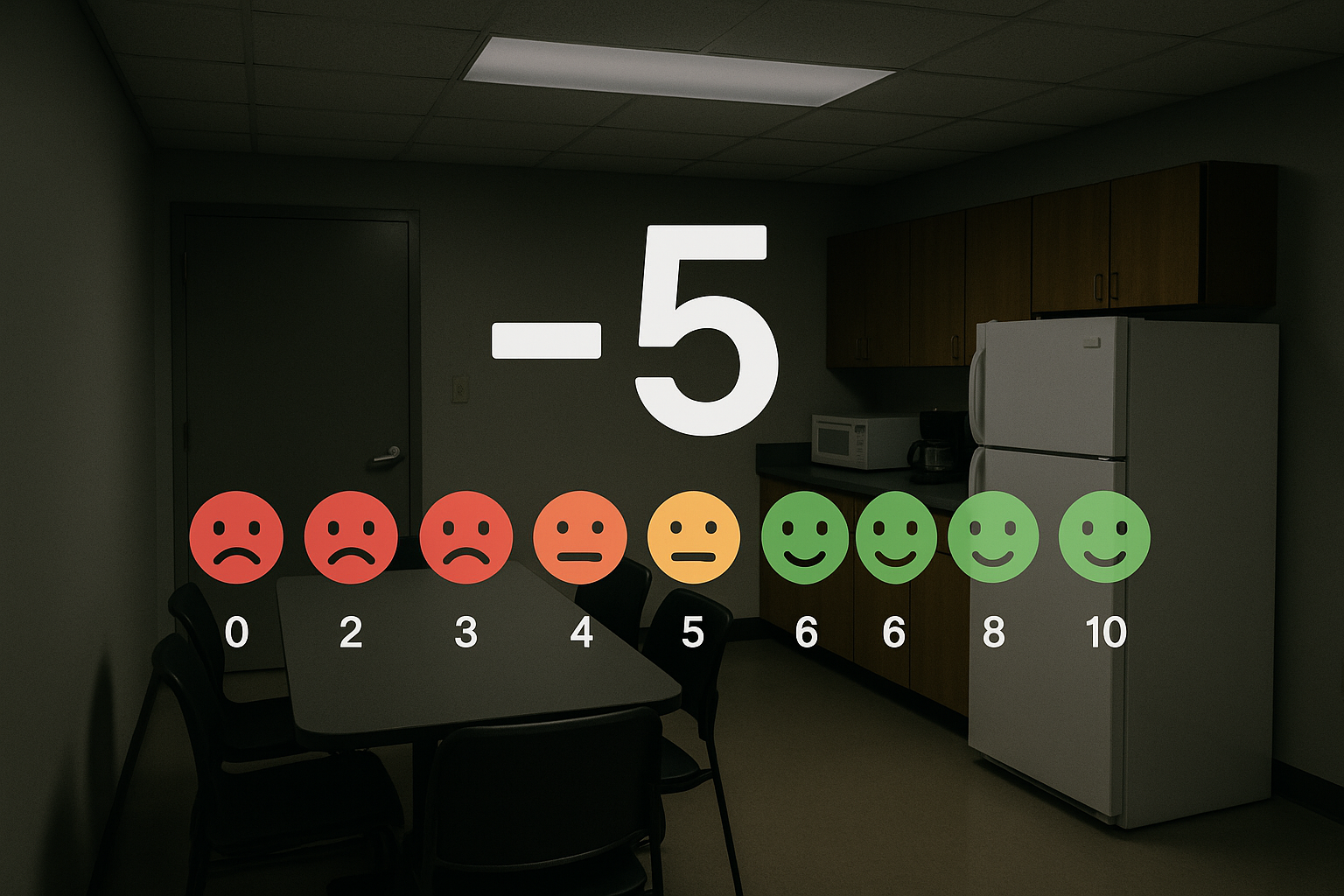
After we committed to going self-funded on January 1st, the first thing I did was I sent our team a simple Net Promoter Score survey asking them to rate their experience with the fully insured plan we were buying from our insurance carrier:
“How likely are you to recommend our health plan to friends or family?”
The score came back: -5
Not 95. Negative 5.
For context:
- Our product NPS: +94
- Our health plan NPS: -5
One of these doesn’t belong.
What They Actually Said
Here’s what our team told us:
“I avoid using the plan every because time I do, I have no idea what its going to cost and I end up with never-ending bills.”
“Their phone support sucks. Also – I just hate them in general, so there’s that ¯_(ツ)_/¯”
“I love using the website to easily find care on my own but avoid calling them at all costs.”
“I don’t trust their ability to track $$$ to save their lives, thus I’m confident we’re paying past our max out of pocket.”
“The one time I really needed them, they denied my surgery after the procedure, having previously stated it would be covered.”
“As a patient I hate being misled.”
And this one hit different:
“I received a letter last month stating that they had leaked my children’s personally identifiable information during a security breach. Now my 3-year-old is on identity monitoring.”
The summary that stung the most?
“It’s no Zero Health.”
The Cadillac Plan Nobody Wanted to Drive
Here’s what made this particularly painful…
We weren’t offering some bare-bones, high-deductible plan.
We had:
- Low deductibles
- Broad network access
- Carrier brand recognition
- All the “right” features on paper
We were paying for a Cadillac.
Our employees were getting a rental car with no GPS, confusing toll charges, and customer service that didn’t act.
Three separate people said they avoid using the plan.
Read that again. Three separate people said they avoid using the plan.
We’re paying six figures annually for a benefit that employees actively avoid using because the experience is so bad.
Coverage ≠ Experience
This is the fundamental problem with traditional health plans. They are optimized for coverage, not experience.
They measure:
- “Access to network” — not “did the member actually get help?”
- “Rich benefits” — not “did anyone use them?”
- “Provider count” — not “was the provider actually accepting new patients?”
Legacy plans are built around features — not outcomes.
But here’s the truth:
Your health plan is a product.
Your employees are the users.
And if your users are giving you a -5 NPS, you don’t have a “benefits problem.”
You have a product problem.
The Questions I Should’ve Asked Earlier
After reading these responses, I started asking different questions:
Not: “Is our network adequate?”
But: “Can employees actually find care when they need it?”
Not: “Are we offering competitive benefits?”
But: “Do employees understand how to use the plan?”
Not: “What’s our loss ratio?”
But: “Are we solving problems or creating them?”
The data was already telling the story:
- 78% loss ratio
- 24% renewal increase
- -5 NPS
We weren’t just overpaying. We were overpaying for something our team did not love.
Why This Matters
Going self-funded isn’t just about cost control.
It’s about taking ownership of the entire experience — from the moment someone needs care to the moment they’re actually better.
Because if I wouldn’t ship a product with a -5 NPS to our customers, why would I accept it for our team?
We plan to fix the product.
We go live in 17 days.
Next week: What we’re actually building, and how we’re measuring whether it works.
