

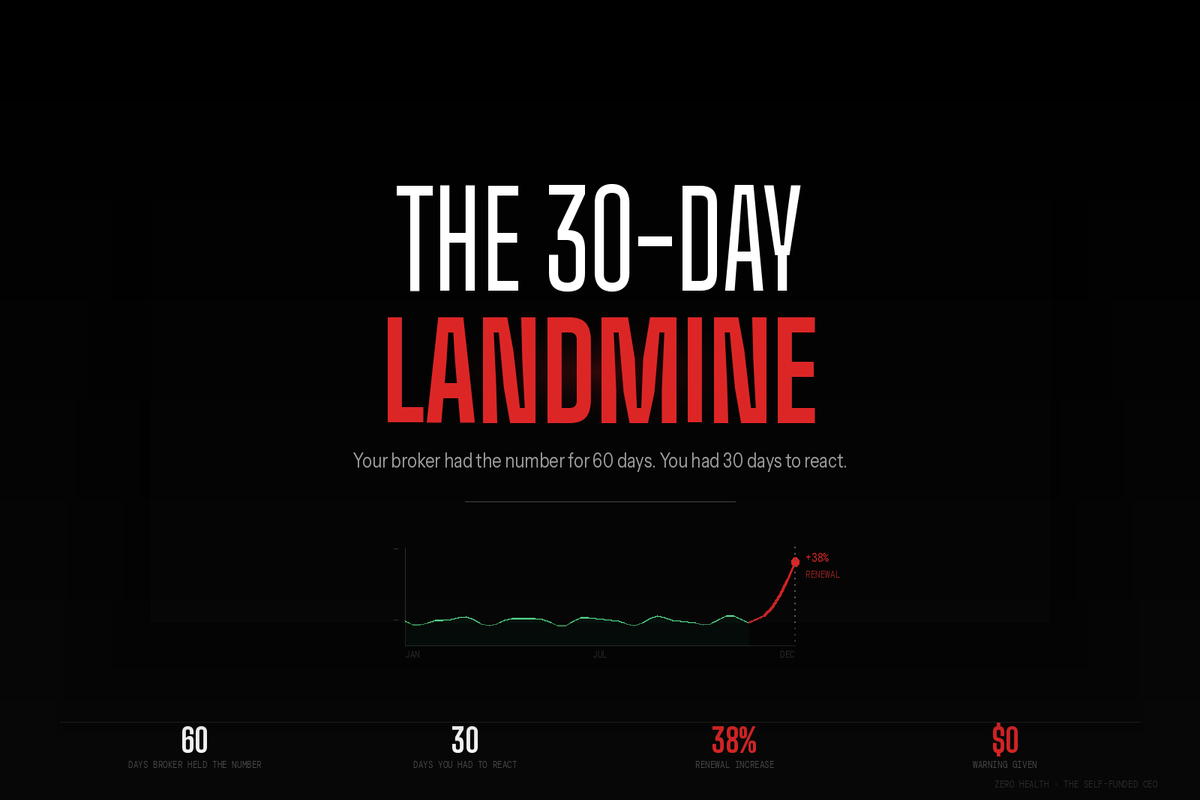
I spoke with a CEO last week. Thirty days before her renewal. Staring at a 38% increase.
Her broker had the number for 60 days before she did. Sixty days. Sat on it.
To be fair — they worked the carrier hard after the fact. But got nothing. The trend that had been building all year, sitting in claims data the broker had access to the whole time.
But here’s what bothers me more than the 60-day hold.
A broker with real tools shouldn’t have been surprised by that number at all. The claims were happening all year. A competent analyst watching that plan month-by-month should have been able to model that renewal 90 days before the carrier even ran the numbers.
So we have two failures. One is communication — the renewal dropped and the broker sat on it for two months. That’s not a process problem. That’s a trust problem.
The second failure is infrastructure. If you have tools to predict a renewal and you’re not proactively surfacing that information to the CEO throughout the year — what exactly is the tool for?
Now here’s what I want you to sit with for a second.
That same CEO almost certainly has full visibility into her sales pipeline. She knows her open opportunities, close rates, average deal size, and projected revenue. Her CRO probably sends a weekly update. She can pull the dashboard herself at any time.
She runs her revenue business in real time.
She has been asked to run her health plan on a 12-month prayer cycle.
There is no logical reason for that gap to exist. The data is there. The math is not hard. The only things missing are the tools (and advisors) to treat a health plan like the operating asset it actually is.
Here’s what I think a great weekly plan update looks like — built the same way a great CRO update is built. Narrative first. Numbers second. And one number that acts as the north star.
The Verdict — a 60-second summary that tells you exactly where the plan stands. Not a spreadsheet. A sentence: plan is on track to be $23oK over budget, NPS is up 33 points in 90 days, there are 2 large claimants that warrant intervention. If the CEO reads nothing else, they read this.
The Numbers — PEPY vs benchmark, actual spend vs. budgeted spend, employee NPS, member out-of-pocket avoided. Four tiles. The ones that actually matter.
And then one more tile that I think should exist but doesn’t yet — at least not the way it should.
I’m calling it FutureRate. The idea is simple: a single number, updated every week from live data, showing the predicted percentage change at renewal. Not a carrier estimate. Not a broker guess. Your own math, running continuously, built on your own experience.
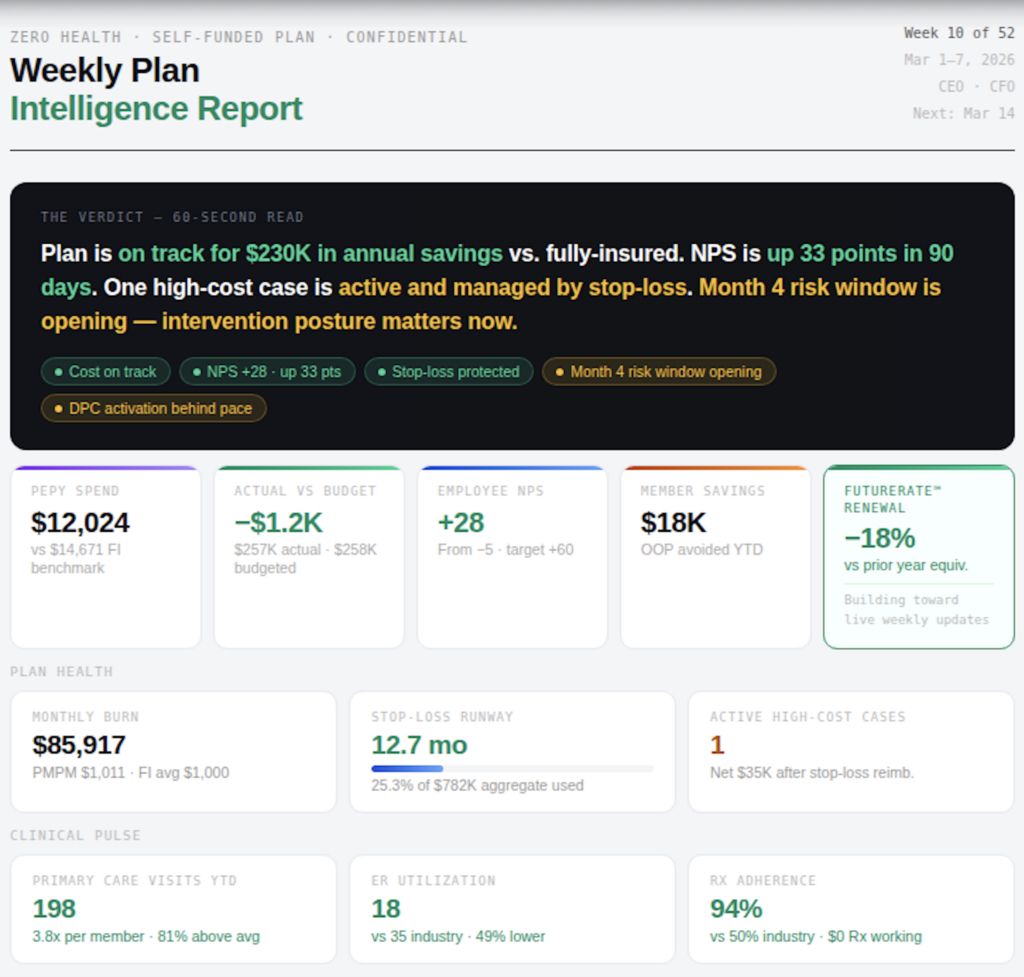
Right now we’re striving to get there. The weekly claims data exists. The trend calculation is straightforward. What I am thinking about building is the infrastructure that makes that number automatic. That surfaces it without anyone having to ask. That puts it in the weekly report alongside NPS and YTD spend so it’s just… always there.
The CEO who I met didn’t need a better negotiation after the fact. She needed that number — visible, weekly, unavoidable — so a 38% renewal was impossible to be surprised by.
That’s what I am thinking about building now. We’re not there yet. But we’re close enough to see exactly what it needs to look like.
I’m building this in public — which means I need your brain, not just your attention.
If you’re a CEO or CFO who has stared down a renewal surprise: what would have changed if you’d seen the trend coming 90 or 180 days out? What would you want in that weekly report that I haven’t mentioned?
If you’re a broker or consultant who’s already built something like this: I want to see it. Show me what you’ve built and how you’re surfacing it to clients.
If you’re an HR leader managing a self-funded plan and the weekly cadence resonates — or doesn’t — tell me why. What’s missing? What’s noise?
And if you’re sitting on a 38% renewal right now and you don’t know what to do with it — send me a message. I’m not selling anything. I’m just learning out loud and I’d rather do it with people who are in the middle of the same problem.
The comments are open. I read every one.
